

Ken Jones, one of our Directors at AF Jones gives an outline of the key project points for our recent natural stone piano room project at Marlands, near Winchester.
This project is for a client with an interest in principles of mathematics as well as music. AF Jones were commissioned as the specialist contractor and advisor for the overall vision which was imagined and produced by Porter Robson Architects.
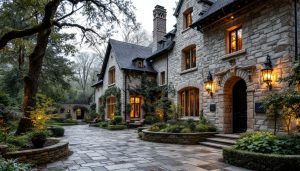
The slender fins for this natural stone project give a distinctive finish to the piano room.
Structural use of Natural Stone
The key challenges here were to ensure that the stone scheme was slender, supported properly, and was integrated carefully with the steelwork framing. We also developed carving and engraving schemes on the fascia entablature to give an ornate and beautifully bespoke design, using carving techniques that met the budgetary constraints set by the client. We also advised on the stone selection, using two distinct continental limestones to meet the particular environmental exposure by location.
Firstly we configured the stone jointing and arrangements for overall elegance and efficiency; this meant making use of the stone fins as structurally active in the support of the entablature, thereby avoiding the need for large or eccentric steel bracketry. We also reduced the number of joints by using longer fins and so improving the uncluttered appearance. Secondly, we designed and detailed the bracketry for suitable structural function, including twist-restraint of the stone fins. We needed 37 different bracket types due to the geometry and install sequence constraints. The junctions were also detailed to allow for the water-proofing membranes, DPC, thermal isolation and structural function. Understanding interfaces and junctions is part and parcel of providing elegant and well detailed stonemasonry.
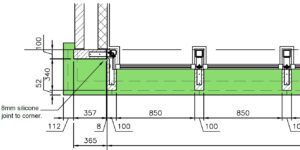
Complex bracketry for integrating the natural stone structure with the steelwork.
Providing a creative response
The artistically creative aspect of the project was in developing the styling for the frieze panels to the entablature which required very close consultation with the client. Having taken an initial brief from the client, I was able to develop concept sketches and then to further develop those into workable carved and etched frieze panels. The panels included grapevines as well as a classical Greek Key patterns. By using a mixture of CNC and sand-blasting technology, we were able to meet the aesthetic intent of the client, whilst also meeting the budgetary constraint too. Overall, this was a very satisfying
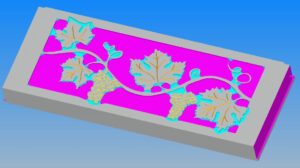
The 3D CAD render for the natural stone frieze around the top of the piano room
achievement; the resulting building has an extra level of personal bespoke artistry which elevates it to more than just ‘special’.
Natural Stone Selection
The slenderness of the fins demanded a strong limestone (stronger than most indigenous British limestones), whilst the coping and plinth levels required a frost-resistant stone that would blend well with the primary stone of the fins and entablature. Therefore, we specified and selected two particular continental limestones for the different zones: Moleanos (Beige) was used for the fins and entablature, whilst Vratz was used for the plinth and copings. They blended exceptionally well and will provide fantastic longevity and performance for the client and future owners of this property.
During the delivery phase we assisted with logistics, scaffolding and lifting requirements for the installation. To get the exact fit up, the process involved effectively dry-laying every single stone before drilling for the pins and brackets. The fins and joints were all rubbed in and dressed to a fantastic smooth and consistent finish.
Through a combination of multiple skills – design & advice, stone sourcing, manufacturing skills, and installation care – we are proud of this fantastic domestic extension of particular elegance, working in positive close collaboration with the architect and builder.
Do you have a project you want to make a reality? Let’s have a conversation about it: info@afjones.co.uk tel: 01491 835032
Frequently Asked Questions
- What are the advantages of using natural stone in architectural designs? Natural stone provides exceptional durability, aesthetic flexibility, and unique textural properties that can enhance the visual impact and longevity of high-end architectural projects, making it a superior choice for bespoke and luxury constructions.
- How does AF Jones ensure the structural integrity and aesthetic appeal of natural stone installations? AF Jones combines advanced technical planning, precise stone selection, and expert craftsmanship. Techniques such as integrating custom bracketry and minimising visible joints are employed to ensure both the structural integrity and seamless beauty of the stone work.
- What specialised techniques are used by AF Jones to achieve detailed and budget-conscious stone carvings? AF Jones employs a combination of CNC machining and sand-blasting technologies to create intricate designs on stone that meet both aesthetic desires and budgetary requirements, ensuring high-quality, cost-effective solutions for intricate architectural features.
- How does the choice of stone affect the overall design and functionality of a structure? Selecting the right stone involves considering factors such as environmental exposure, structural demands, and aesthetic preferences. For instance, using different types of limestone like Moleanos for finesse and Vratz for frost resistance and durability ensures the structure’s beauty and longevity.
- What steps does AF Jones take to ensure successful collaboration and outcome in complex stonemasonry projects? AF Jones prioritises close consultation with clients and architects from the project’s inception through to completion, ensuring every detail aligns with the project’s vision. Comprehensive planning, expert advice, and meticulous attention to detail in sourcing, production, and installation stages are critical.